What a rug pull actually is
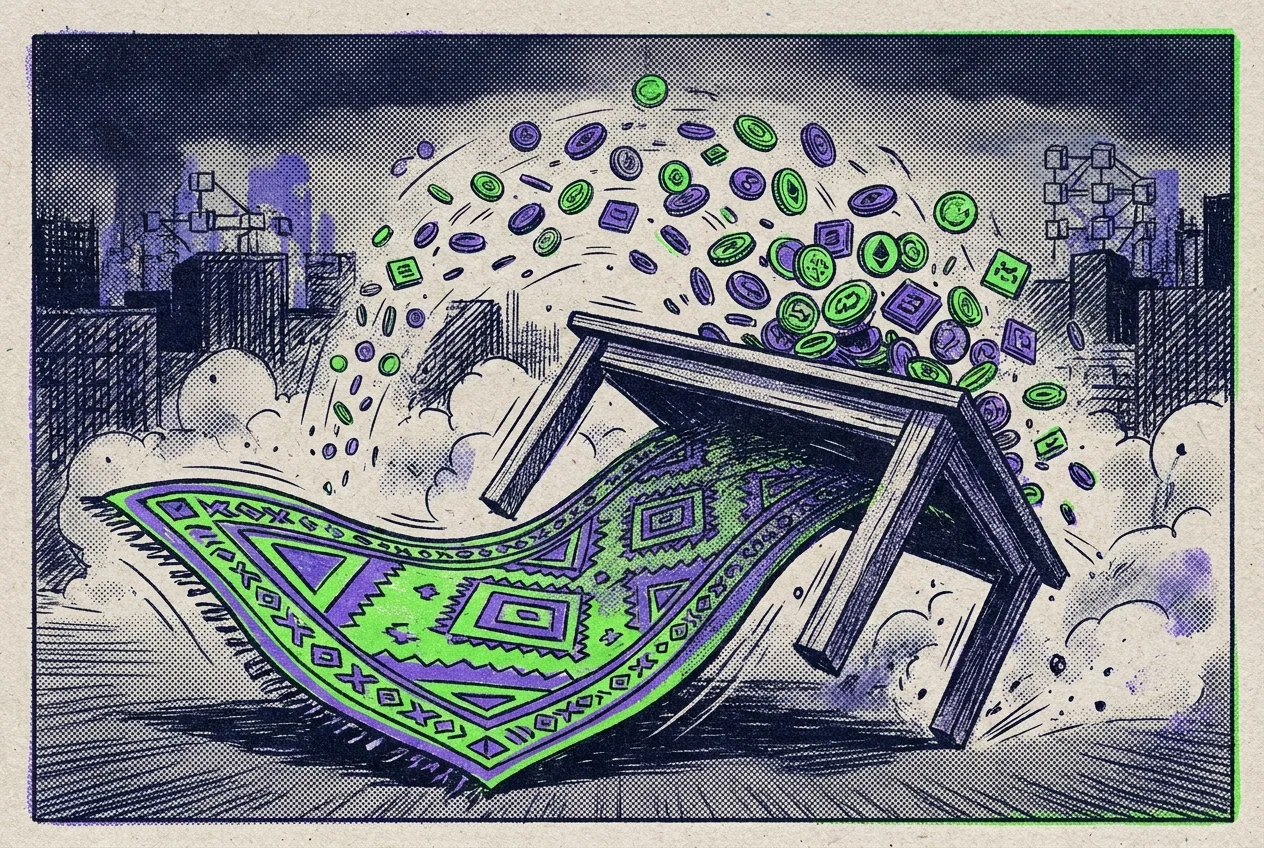
A rug pull is a crypto project designed — or later steered — to take users' money and disappear. The name is literal. You're standing on the rug, feeling fine, and someone yanks it out from under you.
Two main flavors exist:
- Hard rug. The team drains the liquidity pool or triggers a hidden contract power to grab deposits. One transaction. Seconds.
- Soft rug. The team keeps printing and selling their own token, stops shipping anything, and lets the project rot while insiders exit. Slower, quieter, and much more common.
One boundary worth drawing early: a rug is done by insiders. An exploit — like the one that killed the farm that used to live on this domain — is done by an outside attacker. From your wallet's point of view the ending is identical. The prevention isn't, which is why this guide exists.
The red flags, in one table
Most rugs wave several of these flags at once. Treat any single one as a caution. Treat three or more as a verdict.
| Red flag | Why it matters | What to check |
|---|---|---|
| Anonymous team | No reputation at stake means nothing lost by running | Real names, work history, past projects, interviews you can verify |
| No liquidity lock | The team can pull the trading pool at any moment | Lock proof from a known locker service, with the amount and expiry date |
| Mint or owner powers | The contract owner can print tokens or rewrite rules mid-game | The token's page on the chain explorer; owner functions and mint rights |
| Cloned code, rushed launch | Copy-paste farms ship fast and break fast | Project age, forked code with a new logo, countdown-timer hype |
| Nonsense APY | Five-digit yields are paid in confetti | What actually funds the yield; if the answer is "the token itself," beware |
| Buys work, sells don't | Some tokens quietly block selling — a honeypot | Sell transactions from ordinary wallets on the explorer, not just buys |
That last one is exactly as friendly as it sounds. If you can only enter, it's not a market. It's a trap with a ticker symbol.
The five-minute check before any deposit
Run this list every single time. Boring? Extremely. So is keeping your money.
- Look up the token on the chain explorer. If one or two wallets hold most of the supply, walk away.
- Find the liquidity lock. No lock, no deposit. No exceptions.
- Check the team. Named humans with history beat cartoon avatars with promises.
- Ask where the yield comes from. Trading fees and interest are real sources; pure token printing is a countdown. Our yield farming explainer shows how to tell them apart.
- Look for an audit — then remember an audit is a speed bump, not a wall.
- Do a tiny test: deposit a small amount, withdraw it, confirm both directions work.
If any step confuses you, that's information too. Projects that want your trust make these things easy to verify. Projects that want your deposit make them hard.
What a rug looks like in slow motion
Rugs follow a script so consistent you could set a watch by it:
- A new farm appears with a meme name, a countdown clock, and a four-digit APY.
- A dozen influencers you've never heard of all discover it on the same day. Curious, that.
- Early depositors post gain screenshots. Deposits snowball.
- The reward token's chart starts sagging as insiders quietly sell into the hype.
- A sudden "migration," a "v2," or just silence. The social accounts slow down.
- Liquidity vanishes. The chat fills with the saddest word in crypto: "devs?"
The bait in step one is always the same: a yield number too big to ignore. The math of why those numbers are hollow — printed tokens, collapsing rates — is exactly what our APY vs APR guide covers. Read it once and four-digit APYs start looking like warning lights instead of jackpots.
Spotting the next one before it spots you
You won't catch every scam. Professionals miss them. And remember that the Zabu exploit wasn't even a rug — some failures give no warning at all, no matter how careful you are. What the checklist does is cheaply remove the obvious traps. Happily, most traps are obvious.
So set your rules while you're calm, not while a countdown timer is running. Small positions only. Withdrawal tests always. No deposits on launch day, ever — rugs need rush, and patience starves them. And when a week-old farm on Avalanche or anywhere else offers you 4,000% for showing up early, let someone else be early. This is pattern recognition, not financial advice — and the pattern is on your side once you know it.