The short version
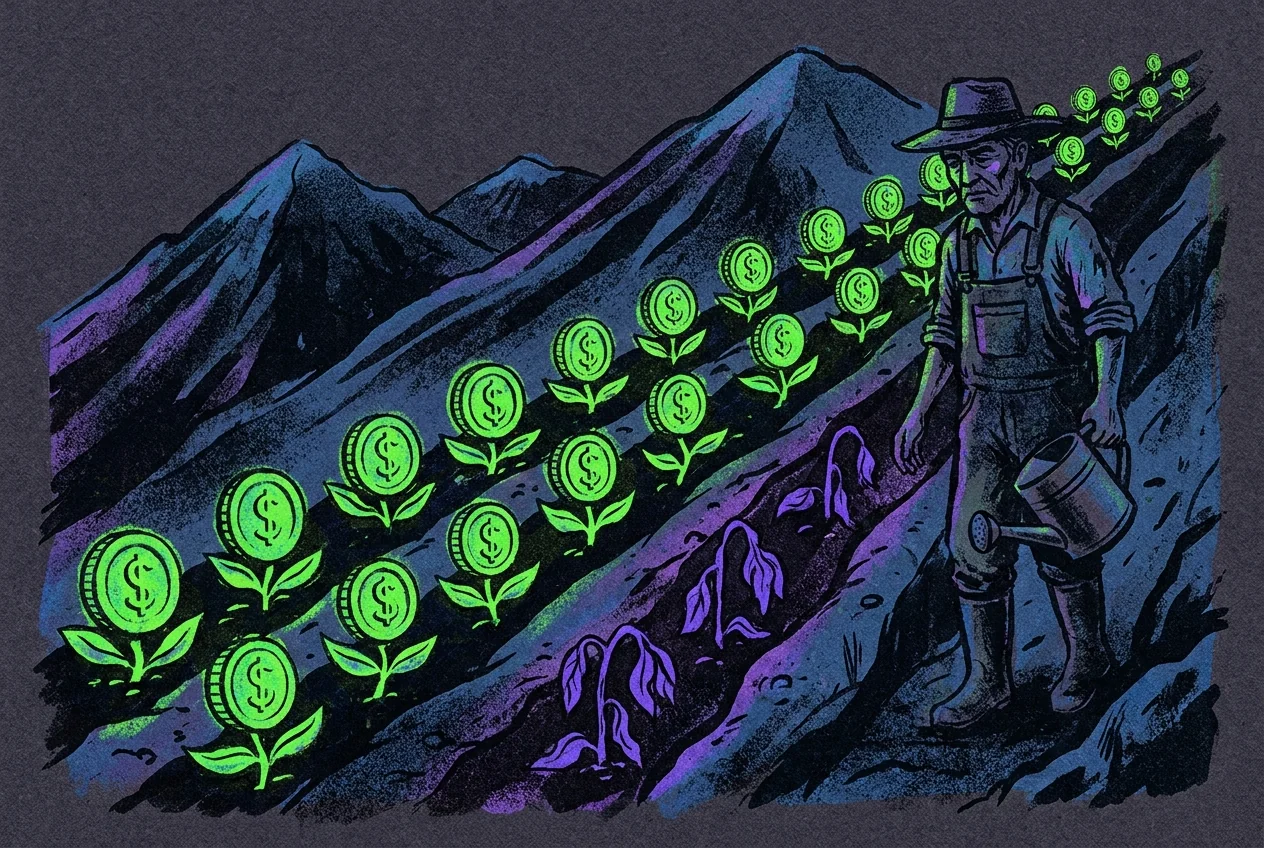
Yield farming means parking your crypto inside a DeFi app so it earns more crypto. Think of it like renting out tools from your garage. The tools are your coins. The rent is your yield.
DeFi is short for decentralized finance. That's a big phrase for a simple idea: financial apps that run on a blockchain, where code does the job a bank would normally do. You connect a wallet, deposit coins, and the app pays you rewards for leaving them there.
That's the pitch, anyway. The catch lives in the details, so let's walk through them slowly.
How the farming loop works
Most farming starts with a liquidity pool. A pool is a shared pot holding two tokens — say AVAX and USDC — that traders swap between. Put your tokens into the pot and you become a liquidity provider, or LP for short.
The app hands you LP tokens as a receipt. They prove your share of the pool.
Now comes the farming part. You stake that receipt — deposit it — into a farm contract. The farm drips rewards to you, usually in the project's own token, for as long as your receipt sits there.
The full loop looks like this:
- Buy two tokens in roughly equal dollar amounts.
- Deposit both into a liquidity pool and get LP tokens back.
- Stake those LP tokens in a farm.
- Collect reward tokens as they drip in.
- Sell the rewards, or re-stake them so they earn too. That's compounding.
Apps like Trader Joe and Pangolin made this loop famous on Avalanche in 2021. Our plain-English guide to Avalanche DeFi tells that whole story, boom and bust included.
Four ways to earn, compared
Farming isn't the only way to earn on coins you already hold. It's just the loudest. Here's how the main options line up.
| Strategy | What you do | Typical APY range (illustrative) | Main risk |
|---|---|---|---|
| Holding | Keep coins in your wallet and wait | 0% | Price falls while you wait |
| Staking | Lock coins to help secure a network | 3–10% | Lock-up periods, slashing penalties |
| Lending | Deposit coins so others can borrow them | 2–8% | Bad debt, platform bugs |
| Yield farming | Provide liquidity, stake the receipt | 5–200%+ | Impermanent loss, exploits, worthless reward tokens |
Those ranges are examples from past market cycles, not offers. Real rates change daily, and the highest ones rarely last a month.
See the pattern? More yield means more moving parts. And every moving part is one more thing that can break while your money sits inside it.
Where the yield comes from
Before you deposit a single coin, ask one question: who's paying me, and why? There are three honest answers.
- Trading fees. Traders pay a small fee on every swap, often around 0.3%. Liquidity providers split it. Real money, usually modest.
- Borrowing interest. On lending apps, borrowers pay interest and depositors receive most of it. Also real, also modest.
- Freshly printed tokens. The farm mints its own token and showers it on depositors. This is where the eye-popping APYs come from.
That third one deserves a hard stare. A reward token is only worth what someone will pay for it. If everyone farms it and sells it, the price sinks, and the 300% APY quietly becomes 30%, then 3%. The math behind those percentages gets its own article — APY vs APR, with worked numbers — because farms lean on that confusion constantly.
Old farmer's rule: if you can't tell where the yield comes from, you are the yield.
The risks nobody puts on the banner
Three risks do most of the damage in farming.
Impermanent loss. When one token in your pool moves a lot in price and the other doesn't, the pool automatically rebalances against you. You end up holding more of the weaker token, and your position can be worth less than if you'd just held both coins in your wallet. The name sounds gentle. The losses aren't always.
Contract risk. Your coins sit inside code, and code has bugs. If the bug is bad enough, the money vanishes in one transaction. That's not a scare story; it's the history of this exact website. In September 2021, the farm that lived on this domain lost about $3.2 million to an accounting flaw. We wrote the full post-mortem.
Rug pulls. Some farms are traps built to take deposits and run. They're depressingly common wherever new tokens promise four-digit yields. Learn the warning signs in our rug-pull field guide before you try anything with real money.
One more thing: an audit badge helps, but it isn't armor. Audited contracts have failed before. The one on this domain did.
So what is yield farming, really?
It's a small business, not a savings account. You're running a tiny market-making shop: you supply inventory (your tokens), you earn revenue (fees and rewards), and you carry genuine business risk (everything above).
Treated that way, farming can be a fine way to learn how DeFi actually works. Start with an amount you could lose without wincing. Pick boring, well-known pools over exciting new ones. And before you deposit, run the numbers through our yield farming calculator so the APY becomes a dollar figure you can judge with a straight face.
Nothing here is financial advice — it's a map of the territory, drawn by a domain that once fell into one of the holes.